An AI-driven retail decision platform and last-mile transportation management suite.
Connect assortment, shelf, inventory, promotions and delivery so teams can automate routine decisions, keep products available and protect margin.
What makes us different
 Unlocking Retail Potential: The Secret Behind Baltic Petroleum’s 62% Sales Growth31:45LEAFIO's difference is the decision loop: assortment, planograms, demand, replenishment and promotions share one platform, and Baltic Petroleum's deputy CEO says the ability to implement two solutions on that platform was the deciding factor.1
- Rather than replace the ERP, LEAFIO uses it as the data foundation and adds specialist AI workflows for SKU-store forecasting, orders and shelf execution.23
- The shelf workflow carries a central planogram into mobile store tasks and AI image checks instead of stopping at an Excel or email handoff.4
- For delivery operations, a Qualiko logistics coordinator says Rinkai TMS made route planning more efficient, systematic and accurate, while the planning engine optimizes cost under capacity, time-window and road constraints.56
One connected decision layer links assortment changes to planograms and replenishment instead of leaving category, shelf and inventory teams in separate systems.
Watch at23:34
 Unlocking Retail Potential: The Secret Behind Baltic Petroleum’s 62% Sales Growthcustomer-video31:45
LEAFIO layers specialized AI modules onto the existing ERP rather than asking retailers to replace their core system.
Watch at2:03
 How LEAFIO Inventory Optimization works: Boost Your Retail Profitability1:13
Demand, shelf-space and assortment decisions are made at SKU-location or store-cluster level rather than from one chain-wide average.
Watch at17:23
 LEAFIO's AI-Powered Demand Planning Software: How It Works0:10
Shelf strategy continues into mobile store execution and AI out-of-shelf checks rather than ending with a static planogram file.
Watch at13:31
 Perfect Planogram Execution: How to Achieve End-to-End Retail Control1:02
Rinkai TMS optimizes last-mile cost while respecting vehicle, capacity, time-window, warehouse and road constraints, then connects the plan with actual execution.
Watch at8:19
 Route Planning Revolution: Qualiko's User Experiences with LEAFIO Rinkai TMS 🚚customer-video0:00
Rinkai TMS can occupy a focused last-mile layer beside an enterprise transport system rather than requiring an all-or-nothing replacement.
Watch at41:18
 Webinar: Unlocking ROI from TMS implementation: Boost Employee Performance and Productivity16:32
Capabilities
LEAFIO AI Retail Platform
Agentic AI AssistantsNewLet AI interpret operational data, explain forecast drivers, flag setup errors and propose or execute corrections within configured rules.Learn more →
The problem it solvesPlanners spend too much time searching reports and diagnosing routine errors before they can act on an exception.
- The solution
- See it
A promotion assistant can explain why a forecast moved, detect planning errors and let the planner correct them in a few clicks. Watch at23:37
For:Retail Executives & Transformation LeadersInventory, Demand & Supply PlannersMerchandising, Category & Space Teams
LEAFIO Inventory OptimizationForecast demand at SKU-store level, maintain adaptive stock targets and generate replenishment orders automatically across stores and distribution centers.Learn more →
The problem it solvesManual or static ordering leaves popular products unavailable while cash remains tied up in excess stock elsewhere.
- The solution
customer-videoLukas Kišonas — Deputy CEO, Baltic PetroleumWatch at33:47
- See it

When sales slow at a store, the target buffer contracts; when demand accelerates, it expands before the next order is generated. Watch at27:46
For:Retail Executives & Transformation LeadersInventory, Demand & Supply Planners
LEAFIO AI Fresh InventoryPlan fresh and perishable inventory with shelf-life, daily demand, delivery-slot and write-off constraints built into each order.Learn more →
The problem it solvesFresh categories force planners to choose between empty shelves and waste when ordinary replenishment ignores expiration and intraday demand.
customer-videoLukas Kišonas — Deputy CEO, Baltic PetroleumWatch at33:47
- See it
A bakery can place multiple orders on the same day, while the calculation accounts for whether deliveries arrive in the morning, afternoon or evening. Watch at1:03
For:Retail Executives & Transformation LeadersInventory, Demand & Supply Planners
LEAFIO Promotion IntelligenceForecast promotional uplift, align inventory throughout the campaign and analyze availability, residual stock and financial performance afterward.Learn more →
The problem it solvesPromo planners frequently protect availability by over-ordering, only to leave working capital trapped in post-promotion stock.
- The solution
- See it

For a new promotional item, the tool identifies analogous products as a reference and then updates upcoming orders from actual sales while the campaign is running. Watch at1:11
For:Retail Executives & Transformation LeadersInventory, Demand & Supply PlannersMerchandising, Category & Space Teams
LEAFIO Shelf EfficiencyCreate data-driven item-level planograms, distribute them to stores and verify execution through mobile tasks, photos and centralized reporting.Learn more →
The problem it solvesSpreadsheet and email workflows make planograms slow to build, inconsistent across stores and difficult to verify after publication.
- The solution
customer-videoMerchandising team member, Plum MarketWatch at0:00
- See it
A central merchandiser publishes a changed planogram, the store employee receives a task in the mobile app, completes the layout and sends a photo back for verification. Watch at11:23
For:Retail Executives & Transformation LeadersMerchandising, Category & Space Teams
LEAFIO Assortment PerformanceBuild store- or cluster-specific assortment strategies and receive AI recommendations for which SKUs to add, remove or replace.Learn more →
The problem it solvesCategory managers cannot continuously review every SKU and store in spreadsheets, so slow movers remain while unmet local demand stays invisible.
- The solution
- See it

A category manager can schedule a Valentine's Day gift pack for selected store clusters; the system warns when activation would exceed a cluster's capacity and passes accepted changes to shelf and inventory workflows. Watch at20:31
For:Retail Executives & Transformation LeadersInventory, Demand & Supply PlannersMerchandising, Category & Space Teams
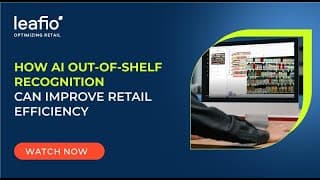
AI-Powered Out-of-Shelf RecognitionDetect shelf gaps automatically from store photos or camera images and distinguish likely stock problems from execution failures.Learn more →
The problem it solvesCentral teams cannot manually inspect every shelf image quickly enough to prevent missed sales and persistent compliance gaps.
- The solution
- See it
In the worked example, the image contains one facing where two were planned, while the system shows 50 units in stock and points to store execution rather than inventory as the likely cause. Watch at18:38
For:Retail Executives & Transformation LeadersInventory, Demand & Supply PlannersMerchandising, Category & Space Teams
Retail Analytics and BIUse role-specific dashboards and drill-down reports to trace inventory, supplier, assortment and shelf-performance problems to individual SKUs and locations.Learn more →
The problem it solvesAggregate sales totals show that performance changed but do not reveal which item, store, supplier or shelf decision caused it.
- The solution
- See it

A planogram manager can compare an item's share of shelf width with its share of sales, then use the facing-change recommendation to increase or decrease its space. Watch at29:40
For:Retail Executives & Transformation LeadersInventory, Demand & Supply PlannersMerchandising, Category & Space Teams
LEAFIO Rinkai TMS
LEAFIO Rinkai TMS Route PlanningBuild cost-efficient last-mile routes from live orders while respecting vehicle, cargo, customer, warehouse and road constraints.Learn more →
The problem it solvesStatic zones and manual routing require excess vehicles, miss delivery windows and cannot consistently account for changing orders or capacity.
- The solution
- See it
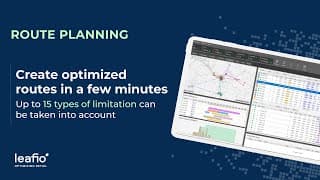
After orders are selected, the optimizer chooses vehicles and stop sequences while filling only the loading slots the depot can actually handle. Watch at7:18
For:Retail Executives & Transformation LeadersLogistics, Dispatch & Delivery Teams
Rinkai TMS Analytics and GPS TrackingCompare planned routes with actual vehicle movement and analyze mileage, sequence, dwell time, service quality and transport cost.Learn more →
The problem it solvesA route plan alone cannot show whether drivers followed it, where delays occurred or which clients and branches create avoidable cost.
- The solution
- See it
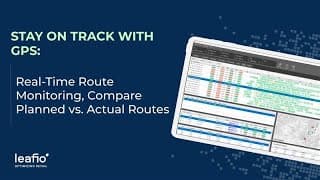
The route map overlays the planned path in purple with the driver's actual path in orange and records unvisited points and unplanned stops. Watch at2:08
For:Retail Executives & Transformation LeadersLogistics, Dispatch & Delivery Teams
LEAFIO RouteSenseGive drivers one mobile app for navigation, order status, barcode scanning, proof of delivery, payments, photos and returns.Learn more →
The problem it solvesPaper documents, phone calls and disconnected navigation leave dispatchers without timely proof or accurate delivery status.
- The solution
- See it
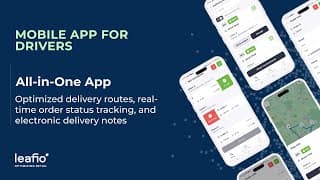
For a partial delivery, the driver changes the quantity, records a reason, confirms payment, adds a photo or comment and sends undelivered goods to the returns-to-depot list. Watch at5:07
Key terms & quotes
- “Driven by expertise, powered by AI.”
- The recurring brand line pairs retail-process knowledge with artificial intelligence. Watch at0:012:02
- “Single unified platform”
- Assortment, shelf, inventory, promotion and related workflows share one connected environment. Watch at2:043:09
- “End-to-end merchandising process”
- Planogram creation, store communication, execution, verification and analysis are treated as one loop. Watch at7:201:02
- “What gets measured gets managed.”
- Operational changes should be tied to visible KPIs rather than intuition alone. Watch at3:1137:49
- “There's no silver bullet.”
- Retail optimization requires data, process changes, implementation work and continued refinement. Watch at20:2745:11
- “Continuous improvement”
- New sales, promotion and execution data should repeatedly feed the next operational decision. Watch at18:2523:38
How we compare
 How to Drive Retail Growth: Roadmap to AI Innovations [Webinar]7:55LEAFIO draws the main retail-platform contrast against broad ERP suites and disconnected departmental tools: the ERP remains the data foundation, while specialized modules add AI-driven assortment, shelf, inventory and promotion decisions.12
- For Rinkai TMS, the market overview separates basic routing tools, focused cloud TMS products and full enterprise suites, placing Rinkai in the SaaS tier for last-mile optimization.3
- Rinkai TMS optimizes cost without dropping time-window, capacity and route constraints, then compares planned routes with GPS actuals.45
- A cited Coca-Cola deployment illustrates coexistence rather than wholesale replacement: ORTEC handled full-truck transport while Rinkai handled last-mile delivery.6
Manual, fragmented and general-purpose systemsLEAFIO characterizes broad ERP suites as the mission-critical data core, but says their all-in-one scope can leave specialist retail decisions slower and less advanced.
LeafioLEAFIO keeps the ERP in place and layers assortment, shelf, inventory and promotion applications onto it through one integration.
Manual, fragmented and general-purpose systemsLEAFIO characterizes separate departmental applications, Excel sheets, email and chat as fragmented handoffs that duplicate support and hide the shared data AI needs.
LeafioLEAFIO uses one platform so an assortment decision can trigger planogram work and replenishment without re-entering the change in each department.
Manual, fragmented and general-purpose systemsLEAFIO characterizes manual ERP adjustments and long-range static forecasts as too slow to follow demand changes at individual SKU-store combinations.
LeafioLEAFIO recalculates SKU-store forecasts, buffers and orders as sales, lead times, seasonality and promotions change.
Manual, fragmented and general-purpose systemsLEAFIO characterizes Excel-, email- and Photoshop-based planograms as slow to distribute, difficult to verify and unable to scale cleanly across large store networks.
LeafioLEAFIO publishes planograms as mobile tasks, records completion evidence and uses AI image recognition to flag shelf gaps.
Manual, fragmented and general-purpose systemsRinkai TMS's market overview characterizes basic route tools as suited to simpler fleets and enterprise suites as broad, higher-cost systems for multimodal transport.
LeafioRinkai TMS sits in the focused SaaS tier for last-mile optimization, providing richer routing than a basic tool without requiring the scope of a full enterprise suite.
Manual, fragmented and general-purpose systemsRinkai TMS characterizes static routes and GPS-only tracking as unable to optimize changing orders and compare execution with an operational plan.
LeafioRinkai TMS generates dynamic routes and then overlays GPS actuals to expose mileage, sequence, dwell-time and service deviations.
Multi-constraint routingLEAFIO Rinkai TMS
Watch at27:57
Manual, fragmented and general-purpose systemsRinkai TMS characterizes route tools that optimize one objective at a time as trading lower cost against time windows, vehicles or service requirements.
LeafioRinkai TMS minimizes cost while continuing to respect vehicle, customer, warehouse, cargo and road constraints in the same calculation.
SAP
In LEAFIO's market framing, SAP represents broad ERP and enterprise-TMS scope, while LEAFIO offers modular retail decision applications and Rinkai offers a focused last-mile SaaS layer.
OracleLEAFIO AI Retail Platform
In LEAFIO's retail-platform comparison, Oracle is grouped with broad ERP suites whose coverage is contrasted with faster, specialist retail modules.
MicrosoftLEAFIO AI Retail Platform
In LEAFIO's retail-platform comparison, Microsoft is grouped with broad ERP options, while LEAFIO is presented as the specialized decision layer around the core system.
Route4MeLEAFIO Rinkai TMS
In Rinkai TMS's market overview, Route4Me is grouped with basic tools for simpler fleet needs, while Rinkai is presented as a focused SaaS system for deeper last-mile optimization.
WialonLEAFIO Rinkai TMS
In Rinkai TMS's market overview, Wialon is characterized primarily as a telematics platform with basic transport-management capabilities, while Rinkai focuses on last-mile route optimization.
MyRouteOnlineLEAFIO Rinkai TMS
In Rinkai TMS's market overview, MyRouteOnline is grouped with basic routing tools, while Rinkai is presented as the more operationally complete SaaS layer for last-mile delivery.
Blue YonderLEAFIO Rinkai TMS
In Rinkai TMS's market overview, Blue Yonder is grouped with broad enterprise transport suites, while Rinkai is presented as a focused and lower-scope last-mile SaaS product.
MercuryGateLEAFIO Rinkai TMS
In Rinkai TMS's market overview, MercuryGate is grouped with broad enterprise transport suites, while Rinkai is presented as a focused last-mile optimization layer.
ORTECLEAFIO Rinkai TMS
In Rinkai TMS's Coca-Cola example, ORTEC handled full-truck transport while Rinkai handled last-mile delivery, illustrating complementary specialization rather than complete replacement.
FAQ
Do I have to replace my ERP to use LEAFIO?
How long does a unified-platform implementation take?
Is the unified platform only for large retail corporations?
Can promotion forecasting handle a SKU that has never been on promotion?

How much history is needed for promotional forecasting?
How do planograms account for different store sizes and sales volumes?

Can planogram analytics work for bulk fruits and vegetables?
Yes, but unpackaged products are not analyzed as individual pieces.
Can I try Rinkai TMS before buying it?
Rinkai TMS does not offer a self-service trial because useful testing requires implementation.